


.avif)



Sales is one of the few professions that’s performance-based, yet practice is rare and inconsistent. Reps are expected to execute in high-stakes moments, discovery, objections, negotiation, and messaging, often without ever rehearsing those scenarios in a realistic way. That gap is expensive: When practice is missing, reps default to comfort moves, deals stall, and managers end up coaching reactively after damage is already done.
That’s what makes AI sales role play so valuable. It creates consistent, on-demand reps without needing a partner, and it gives sellers a safe place to try, fail, adjust, and repeat before they’re on a six-figure call.
When you pair that repetition with AI sales coaching, clear standards, targeted feedback, and reinforcement inside a repeatable system, practice stops being random activity and starts becoming a measurable skill-building.
What Problem Does AI Sales Role Play Actually Solve?
When sales training is done right, it can lead to more than 350% ROI. But traditional sales training has many issues; it’s too generic, hands off, and doesn’t tie skills to business outcomes.
Introducing AI sales role play, which solves a laundry list of real problems that sales orgs like yours are dealing with:
- Enables unlimited, on-demand practice without a partner: No more waiting for a manager, a peer, or a quarterly enablement session. Reps can practice discovery, objection handling, or negotiation whenever the skill gap shows up (and before the critical call).
- Removes manager and calendar bottlenecks: One of the main reasons why sales training fails is because frontline managers don’t always have the time to run live role plays at the frequency required for real skill change. AI eliminates that dependency and allows valuable practice to happen in the flow of work.
- Creates a safe environment for failure and retry: Reps don’t avoid practice because they don’t care; they avoid it because public failure is uncomfortable. Sales roleplay software removes the social risk. Reps can try, miss, adjust, and retry without burning credibility or confidence.
The advantage isn’t just more practice, it’s consistent practice on the right skills, at the right time, with enough repetition to change behavior.
But here’s the critical factor most teams miss: Practice volume ≠ performance improvement.
Reps talking to a bot more often doesn’t automatically translate to higher win rates. If you want to build durable skill capacity, practice needs to be aligned to the right skills, grounded in realistic scenarios, and reinforced over time.
The Big Warning: How Can AI Role Play Without a System Make Reps Worse?
AI sales training software is a powerful tool. But without the right structure and support, it can actually degrade performance.
Here’s how a lot of teams get burned:
- Random practice reinforces bad habits: If reps are practicing without a defined standard for what good looks like, they’re not building skill; they’re doubling down on mistakes.
- Practicing the wrong skill compounds poor behavior: Most sales problems aren’t broad, and reps don’t need general sales training. When AI role play isn’t anchored to the right skill at the right moment, reps get better at the wrong things.
- False confidence emerges without standards or feedback loops: Reps feel fluent because they’ve practiced a lot, but no one has told them they’re practicing incorrectly. Without clear scoring, benchmarks, and feedback tied to real outcomes, confidence rises while win rates stay flat.
When standards and feedback loops are missing, AI can scale repetition, but it can just as easily scale the wrong behaviors.
Think of it like golf. A golfer who repeats a flawed swing doesn’t slowly get better; they get really consistent at being wrong.
AI role play without a strong sales training process does the same thing. It accelerates muscle memory, even if the motion isn’t correct.
What Is the Revenue Excellence Flywheel and Why Does It Matter?
Most sales orgs treat improvement like a straight line: Train → hope → miss quota → repeat. That’s exactly why skill decay keeps compounding.
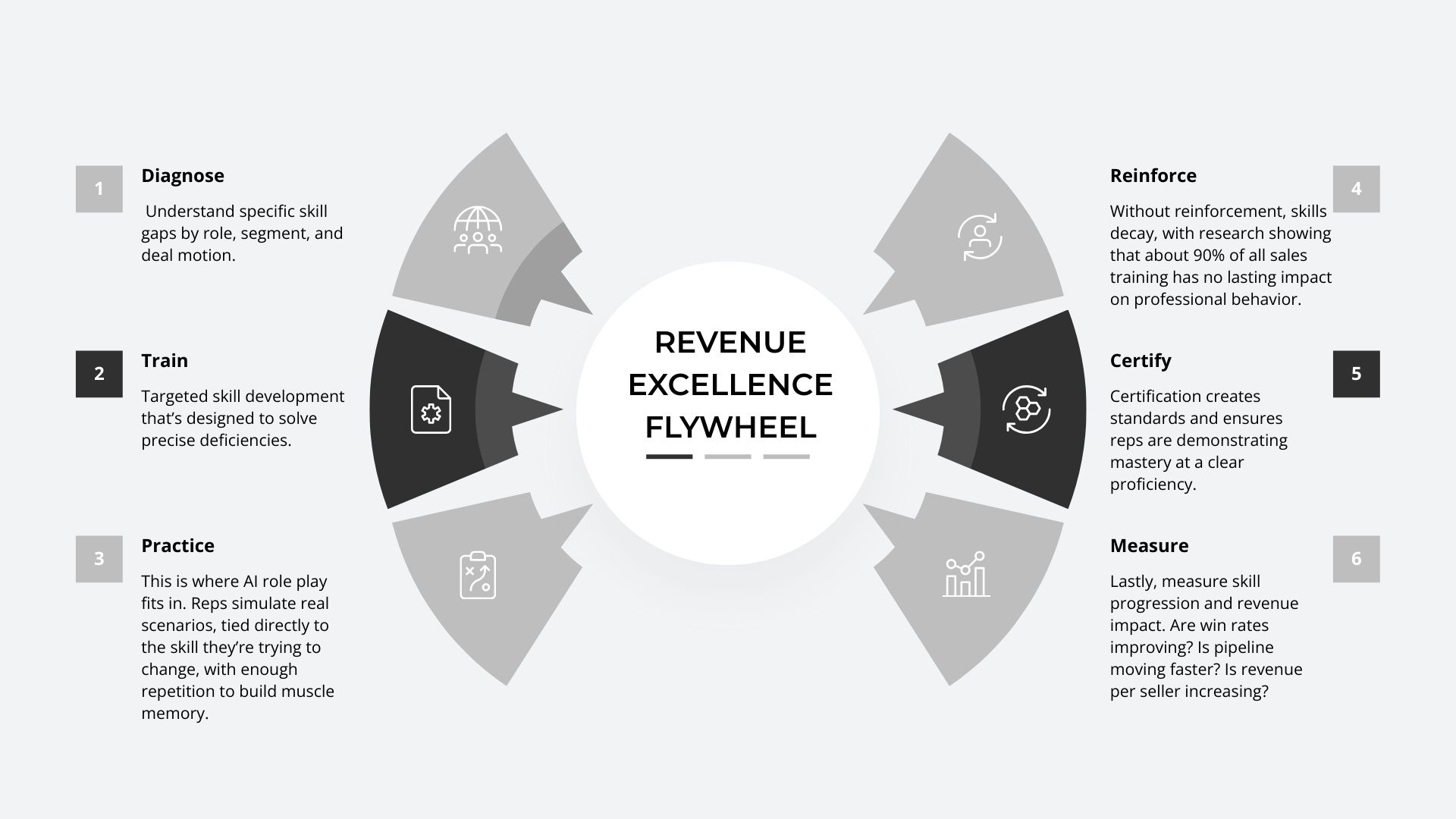
Instead, meet the Revenue Excellence Flywheel, which reframes sales improvement as a closed-loop system.
Here’s the six-stage cycle that actually drives durable performance improvements:
- Diagnose: Understand specific skill gaps by role, segment, and deal motion.
- Train: Targeted skill development that’s designed to solve precise deficiencies.
- Practice: This is where AI role play fits in. Reps simulate real scenarios, tied directly to the skill they’re trying to change, with enough repetition to build muscle memory.
- Reinforce: Without reinforcement, skills decay, with research showing that about 90% of all sales training has no lasting impact on professional behavior. But reinforcement ensures new skills stick, closing the gap between learning and execution through repetition, feedback, and refreshers.
- Certify: Certification creates standards and ensures reps are demonstrating mastery at a clear proficiency.
- Measure: Lastly, measure skill progression and revenue impact. Are win rates improving? Is pipeline moving faster? Is revenue per seller increasing? Measuring allows you to not only track skill transformation, but use feedback to feed the next diagnostic cycle, so improvement compounds.
The flywheel works because each stage feeds the next, making skill development measurable, repeatable, and compounding over time.
How Should Teams Diagnose Before Using AI Sales Role Play?
AI sales role play allows reps to practice their new skills with high frequency, safe space for failure, and scenario variety. But too many teams skip diagnosis and jump straight into “Let’s role play objection handling.”
But:
- Which objections?
- In which role?
- At which deal stage?
If the scenario isn’t specific, the practice won’t map cleanly to real calls, so improvements stay abstract instead of showing up in pipeline.
Instead, start with a diagnosis step that identifies skill capacity gaps that limit revenue outcomes. This can be done through analysis, skill profile design, and by connecting specific skills to business outcomes.
For example, with pclub.io’s skill transformation platform, you get access to an embedded diagnosis step, which includes:
- Revenue win/loss analysis: Identify revenue-damaging skill gaps and connect them to business outcomes.
- Role-based skill profile design: Understand what abilities drive success for SDRs, AEs, CSMs, etc.
- Team skill assessment: Analyze the depth of skills teams have against skill profiles.
Diagnosis turns role play from generic activity into targeted practice that’s tied to revenue outcomes.
Ready to Move Beyond Random Reps and Build Real Sales Performance?
AI sales role play can help your team have a massive skill breakthrough. But it won’t happen with just role play. Practice needs to be embedded inside a revenue system, one that closes the right gaps, trains to a solid standard, and reinforces behavior.
If you’re serious about leveraging AI role play as a serious competitive advantage, plcub is here to help. We’re the #1 revenue skill transformation system built for teams which refuse to be average.
Talk to us today to explore what AI role play looks like inside a true revenue system, so you can build elite skills and drive significant revenue improvements.
FAQs
If you’re evaluating AI sales coaching or trying to roll it out without creating more noise, these are the questions sales leaders ask most often. Here are quick, practical answers to help you decide what matters and what to ignore.
How Effective Is AI Sales Role Play Compared to Traditional Role Play?
AI sales role play can be far more effective than legacy role play. AI wins on volume, consistency, and access. Reps can practice as often as they like, avoid awkward moments, and receive even feedback.
The catch? AI needs to be tied to clear standards and reinforcement.
Can AI Sales Role Play Replace Sales Coaching and Managers?
Not necessarily. AI sales role play needs to be reinforced, held to specific standards, and new performance needs to be measured.
Instead, AI should replace manager bottlenecks, handling high-frequency practice, scenario simulation, and baseline feedback. This allows managers to stay focused on judgment, deal strategy, and coaching to business context.
What Sales Skills Should Reps Practice First With AI Role Play?
Start by diagnosing where revenue is leaking, tied to rep role and motion. For many teams, that’s skills like discovery depth, accessing power, objection handling, next-step control, and negotiation framing. Avoid generic pitch practice, and use AI to surgically improve behaviors tied to business outcomes.
.svg)



.svg)
.webp)

