

Sales Methodologies Are Dead. Here’s What Top Revenue Leaders Are Doing Instead.


The term “sales methodology” emerged in the 1970s and 80s.
And back then, it did something transformational:
It brought structure to a profession that operated like the wild west, fueled by personality, charisma, and long, boozy lunches.
Put simply:
“Sales methodology” brought clarity to a business function that, until then, had almost none.
It took the sales profession from zero to one — from total ambiguity about what drives predictable success to at least a baseline level of order.
But that was 40–50 years ago.
Since then, the sales profession has advanced dramatically on every dimension. We’re no longer at zero to one. We’ve gone from one to ten.
And yet we’re still using a term (“sales methodology”) that was designed only to serve that first step toward clarity.
In today’s far more advanced sales environment, the term doesn’t just fall short – it actually creates more harm than good.
Here’s Why:
Ask 10 sales professionals to define “sales methodology,” and you’ll get 10 different answers.
“A common language for selling.”
“A certain way to approach the sale.”
“The steps you take from start to close.”
Sure, the themes overlap. But there’s nowhere near enough agreement on what the term actually means.
And that pulls us right back from clarity into ambiguity.
In fact, when you look at the most popular “sales methodologies,” you’ll notice they’re all describing completely different things.
Here are a few examples:
The Challenger Sale
The Challenger framework tells sellers to Teach, Tailor, and Take Control.
But is that a methodology? I’m not convinced. It reads much more like a behavioral philosophy to carry through a sales cycle.
But let’s keep going:
Challenger also outlines six steps for delivering commercial insight:
- The Warmer
- The Reframe
- Rational Drowning
- Emotional Impact
- The New Way
- Your Solution
But again—does that constitute a “sales methodology”?
It’s definitely a “methodology” of some sort.
But is it comprehensive enough to span the entirety of a deal cycle?
Is this all reps need to do to successfully close complex deals?
To me, it’s closer to a methodology for executing one specific meeting within an otherwise complex sales process, not a methodology for the entire motion.
SPIN Selling and Solution Selling
I’m grouping these together intentionally.
Why?
Because neither one is actually a “sales methodology.”
Both are discovery methodologies — and while discovery is crucial, it’s still only one component of a complex B2B sales motion.
SPIN Selling teaches four types of questions:
- Situation
- Problem
- Implication
- Need-payoff
Solution Selling teaches a structured 9-box question model:
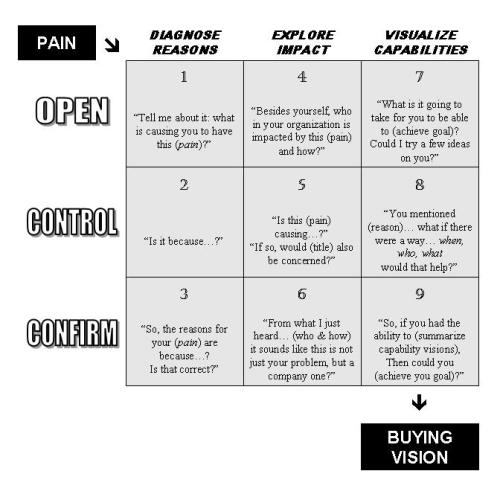
Both approaches are highly valuable – I’ve used elements from each to shape my own discovery process.
But again: discovery is just one chapter in the book of a full deal cycle.
Neither SPIN nor Solution Selling covers the broader execution required to win complex deals, such as:
- Champion development
- Accessing and selling to power
- Multi-threading high and wide
- Negotiating and closing
- Value messaging and presenting solutions
- Prospecting
- And more
In other words, they’re excellent discovery frameworks – but they’re nowhere close to full “sales methodologies.”
Sandler
The Sandler Selling System was created in the 1960s by David Sandler — a man who sold door-to-door to consumers.
And over the decades, Sandler has been adopted by almost any selling environment that will take it.
Sales teams selling steak knives door to door use Sandler.
Sales teams selling ERP software to the Fortune 500 use Sandler.
That alone tells you something:
This “methodology” has been stretched far beyond its original context.
In the graphic commonly used to represent Sandler, you’ll see 7 steps:
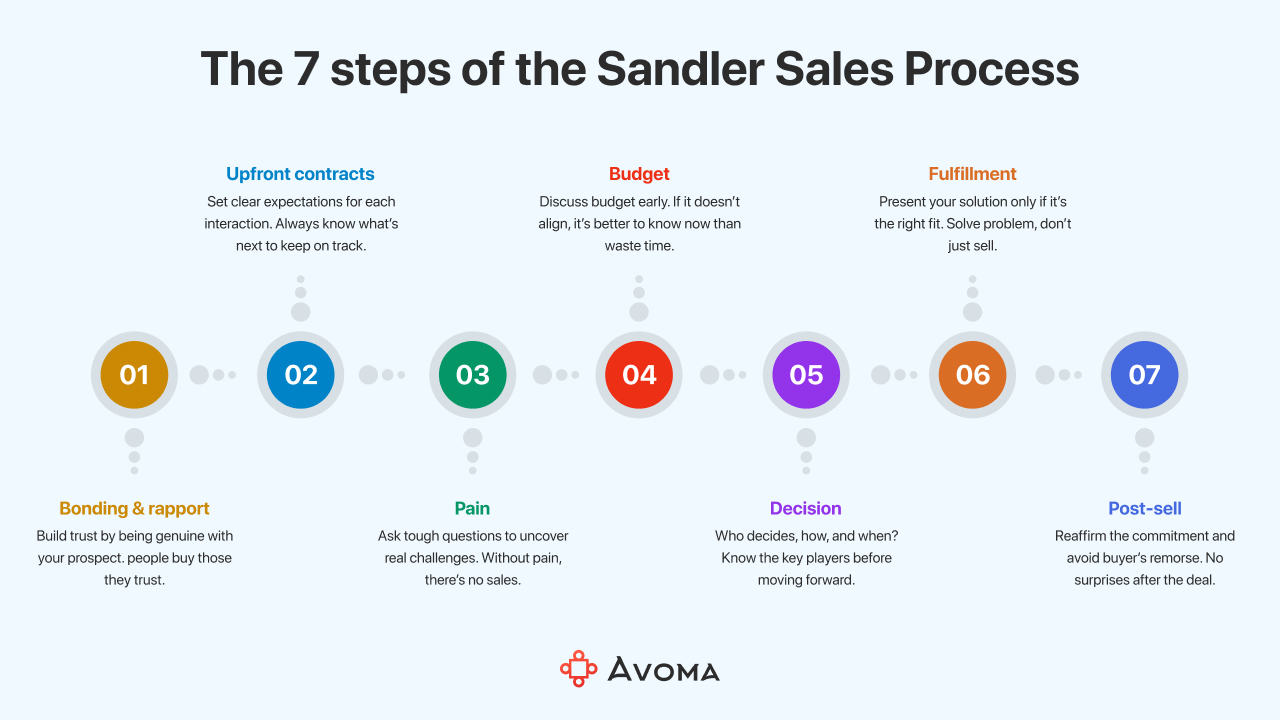
But take a closer look.
The first five steps are essentially a blend of discovery and qualification.
Those are things that – in a typical B2B sales cycle – are often done one the first of a dozen calls along a sales cycle.
And then—almost abruptly—you jump straight to fulfillment. There’s no clear connective tissue that links these steps into a coherent, end-to-end sales motion.
As a result, Sandler tends to get distilled down into a handful of recognizable techniques:
- Upfront contracts (its most famous tactic)
- The Pain Funnel (a questioning sequence)
- The Sandler Submarine (a metaphor for progressing through steps without “going back up”)
So what exactly is Sandler?
A “sales methodology”?
A collection of clever sales tactics?
A repurposed consumer-selling approach now applied everywhere?
It’s hard to say — and that ambiguity is the point. Sandler is influential, but it’s nowhere close to a modern, comprehensive sales methodology.
That’s not me bad-mouthing Sandler – don't misunderstand.
I’m simply pointing out the dissonance of using the word “sales methodology.”
Let’s do one more.
MEDDICC
This is the one that gets misclassified more than anything else.
Any time I hear a revenue leader call MEDDPICC a “sales methodology,” one of two things is usually true:
- They aren’t very precise with their language (which matters enormously in sales leadership), or
- They still have a lot to learn
Even John McMahon — one of MEDDPICC’s biggest champions — is explicit that it is not a sales methodology.
It’s an internal deal qualification framework.
If you need a refresher, MEDDPICC stands for:
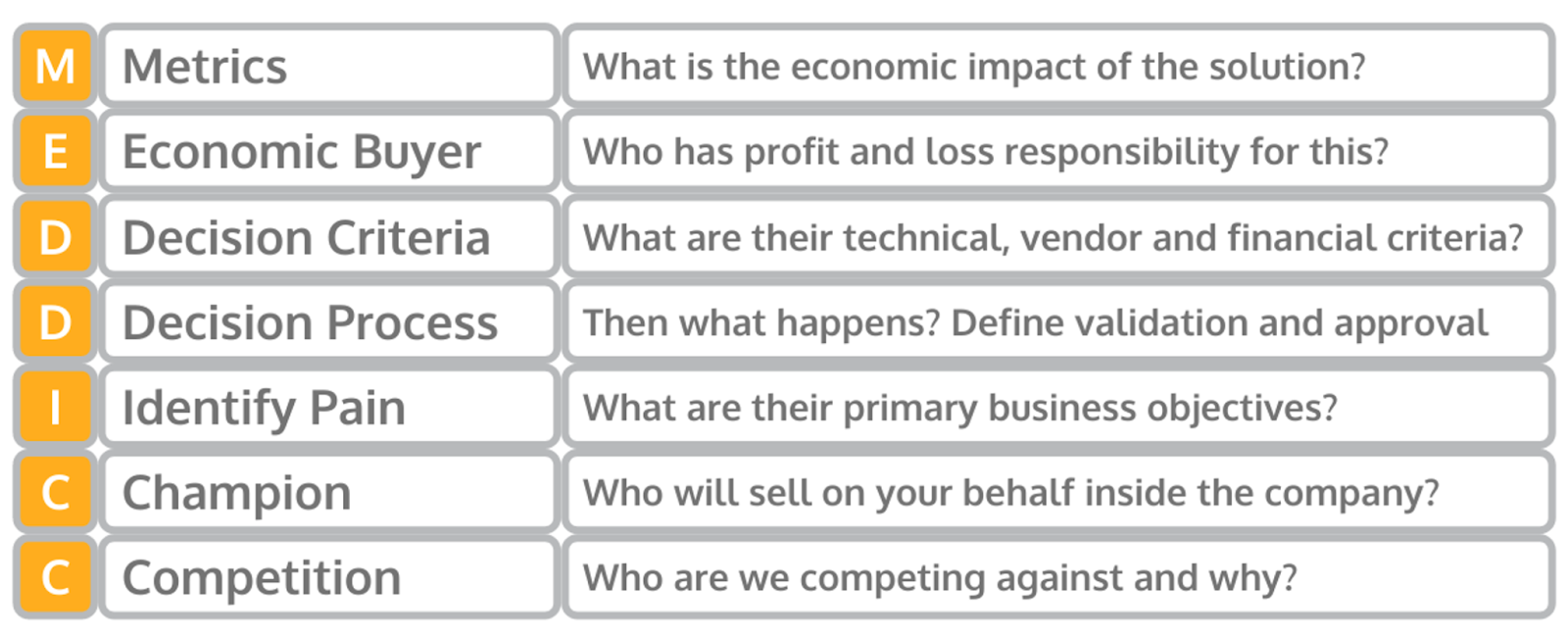
In other words, it’s a checklist of elements that make up a healthy (or unhealthy) deal — nothing more and nothing less.
Yet many revenue leaders “roll out MEDDPICC,” tell their reps to qualify deals against the acronym, and then wonder why their teams can recite the letters… but can’t actually execute a deal against any of them consistently.
“Sales Methodologies” Are Dead. Here’s What To Do Instead
After 15 years working directly with VPs of Sales and Chief Revenue Officers, one pattern is unmistakable:
The highest-performing leaders almost never use a “sales methodology.”
Why?
Because the term “sales methodology,” in today’s environment, creates more ambiguity than clarity. It obscures what actually drives predictable revenue.
Instead, elite revenue organizations rely on two components to create true clarity and operational excellence:
First: Sales Stages & Exit Criteria (Clarity)
When you nail this, your sellers gain complete clarity on what it takes to move a deal from open to closed.
Here’s an example of what these look like (these are mine, for the record):
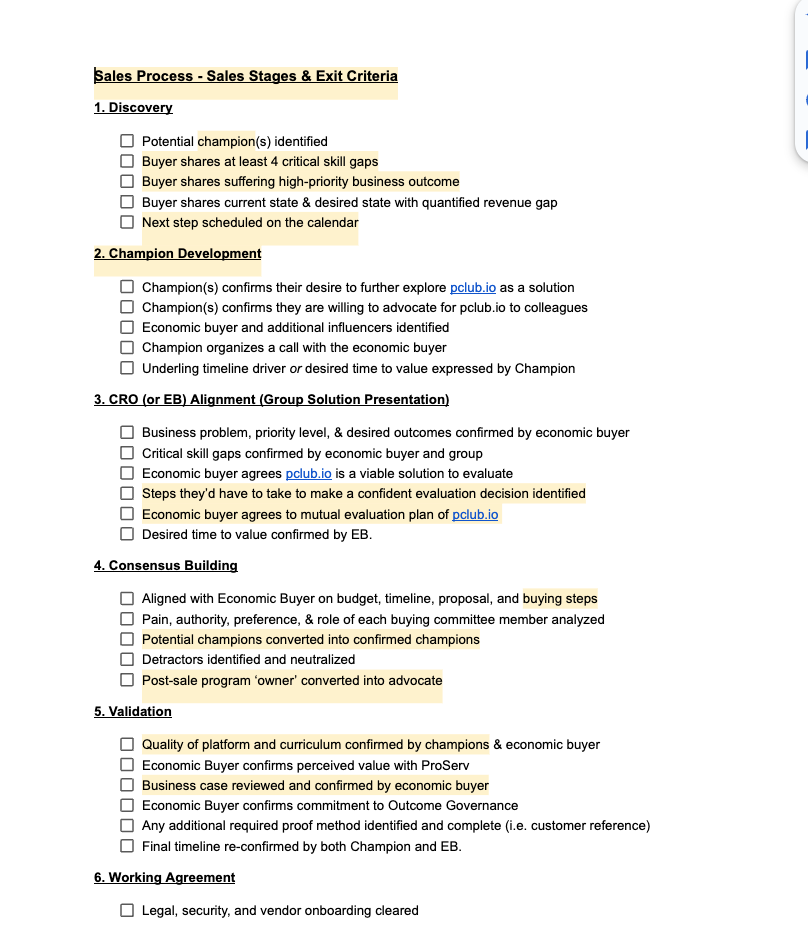
The stages act as the compass.
The exit criteria—customer-verified, precise, and non-negotiable—tell reps exactly what must be true to advance to the next stage.
With clearly defined stages and exit criteria, everyone speaks the same language. Reps know where they’re stuck. They know what to do next. And managers can coach with surgical precision instead of guesswork.
But clarity alone isn’t enough.
Stages and exit criteria tell sellers what to do.
They don’t give them the ability to do it.
Second: Skill Capacity (Ability)
If stages and exit criteria define what to do, then skills define how to do it—and how well.
Look back at the stages above. A rep may now know exactly what needs to happen. But do they possess the skill required to execute?
A few essential examples:
- Discovery: Identifying and quantifying pain; diagnosing root causes
- Demos Effectiveness: Demonstrating how your solution resolves the problem
- Champion Development: Converting an interested advocate into someone willing to spend political capital for you
- Executive Selling: Aligning with the economic buyer on a mutual evaluation
- Multi-threading: Accessing key stakeholders without alienating your original POC
- Consensus Building: Driving a unified point of view across a multi-threaded committee
- Closing & Negotiation: Securing the contract on time at the price and terms you need.
Skills are the difference between knowing the right next step… and being capable of executing it consistently.
Now step back and look at your own organization.
Which is more powerful?
Rolling out a book that offers its own definition of “sales methodology”?
Or equipping your team with:
- Crisp sales stages & exit criteria, and
- Sellers trained deeply on the skills needed to execute them?
There’s no comparison.
Rocket + Rocket Fuel
Running a sales organization is like traveling through space.
First, you need the rocket.
That’s your sales process—the structure that gets you from one planet to another.
But a rocket without fuel goes nowhere.
Skill capacity is the fuel. It’s what propels the process forward.
Process is structure.
Skill is propulsion.
You cannot win without both.
Skill without process is chaos.
Process without skill is academically strong, commercially weak.
So where does that leave the term “methodology?”
If you look closely, most of the so-called methodologies aren’t “sales methodologies” at all.
They’re skill methodologies:
- SPIN teaches a discovery methodology.
- Solution Selling teaches a diagnostic questioning methodology.
- Challenger teaches an executive presentation methodology.
All valuable.
None comprehensive.
So what role does the term “sales methodology” play today?
None.
And that’s perfectly fine.
It served its purpose.
Not only do we not need it anymore, but using it has harmful consequences, as I hope you’re convinced of now.
In the 70s and 80s—when the sales profession was a mysterious black box—it provided the first hint of structure.
But today?
We’ve outgrown it.
We’ve entered a far more advanced era of professional clarity, and the word “methodology” no longer reflects how modern revenue organizations actually operate.
The Bottom Line
The world’s best revenue leaders don’t rely on vague methodologies.
They rely on two interlocking pillars of revenue excellence:
- Sales Process — what to do (the rocket)
- Skill Capacity — how to do it (the fuel)
Get these two right, and you don’t just create clarity.
You build a revenue organization capable of extraordinary, repeatable performance.