

The Sobering Truth: Weak Sales Teams Get Worse Over Time, Research Shows


Weak sales teams that have major skill gaps don’t stay the same. They get worse. Our analysis of 1,592 AEs shows why.
Everyone knows about the slippery slope of financial debt:
The longer it goes unaddressed, the harder it becomes to fix.
Debt compounds negatively.
Neglecting to upskill your revenue team works the same way.
The longer you wait to address revenue-damaging skill gaps, the harder they become to improve.
It’s called “Skill Debt.”
Here’s how it wreaks havoc:
We Analyzed the Skills of 1,592 AEs
Our research team here at pclub.io analyzed the discovery skills of 1,592 B2B technology account executives across 36 companies before and after running the same 30-day discovery skill training program.
The program included on-demand expert-led training, AI practice simulations, and AI skill progression measurement – a multi-modal program that addressed all aspects of the skill acquisition journey.
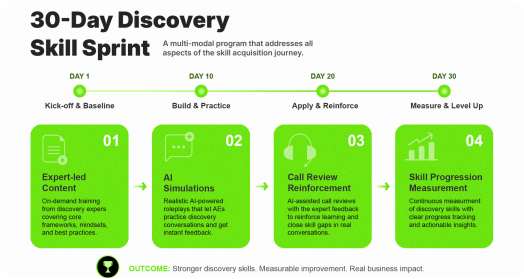
First, We Baselined Their Skill Proficiency Levels
Before running the discovery program with these sellers, we baselined their discovery skill proficiency levels.
90 days worth of their discovery calls & deal cycles were analyzed with AI against a standardized skill proficiency scale that scored their Overall Rating (OVR) for Discovery Skills ranging from 0–100 across a spectrum from Novice → Developing → Fair → Proficient → Expert.

It’s important to note that they were not measured against any specific discovery “methodology,” such as SPIN Selling, GAP Selling, or anything like that.
Rather, they were measured against methodology-agnostic, universal truths about effective discovery – first principles that apply regardless of your selling environment, such as: • How effectively did the seller uncover high-priority, strategic pain?
- How effectively did the seller diagnose the root cause(s) of the buyer’s problem? • How conversational did the seller make the interaction feel, avoiding an atmosphere of interrogation?
- To what extent did the seller quantify the buyer’s problem in specific, measurable financial terms or risk?
And so on.
That gave us a skill proficiency baseline across the sellers as a pre-training starting point. Now here’s what happened next:
Two AE Training Cohorts: Immediate vs. Delayed Enrollment
We then split the total population of AEs into two distinct cohorts.
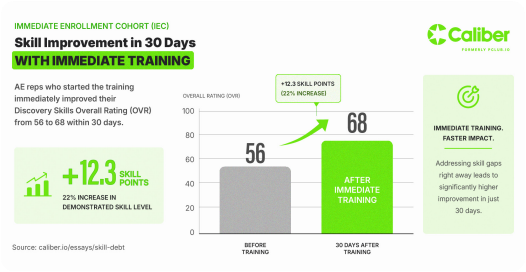
The first cohort was called the Immediate Enrollment Cohort (IEC).
In this cohort, we ran the 30 day training program immediately after analyzing their previous 90 days worth of discovery calls.
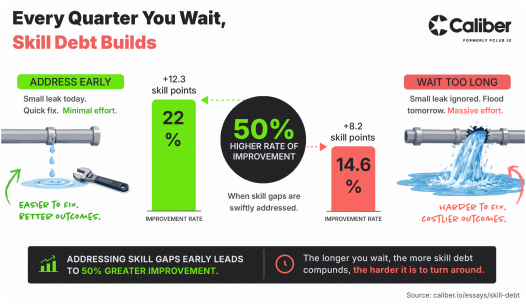
Reps who entered this immediate enrollment cohort improved their proficiency level an average of 12.3 skill points within 30 days of completing the training program.
That’s a 22% increase in demonstrated skill level.
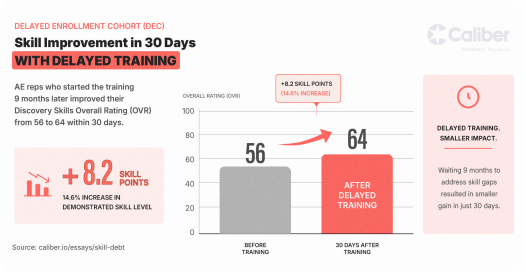
The second cohort was called the Delayed Enrollment Cohort (DEC).
In this cohort, we waited to run the 30 day training program a full 9 months after analyzing 90 days worth of their discovery calls.
In other words, their skill gap was left unaddressed 9 months longer than the first cohort.
Reps who entered this DEC cohort only managed to improve their proficiency level by 8.2 skill points within 30 days of completing the training program.
That’s only a 14.6% increase in skill level for those whose skills gaps were addressed slowly.

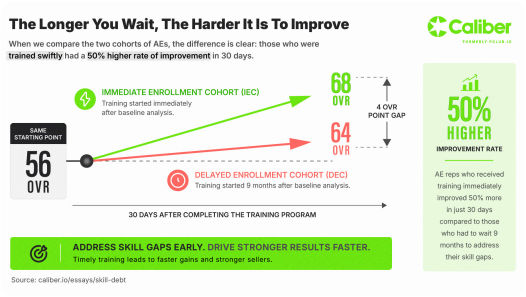
Delaying skill development doesn’t just slow the rate of improvement – Given the direct connection between seller capabilities and revenue outcomes:
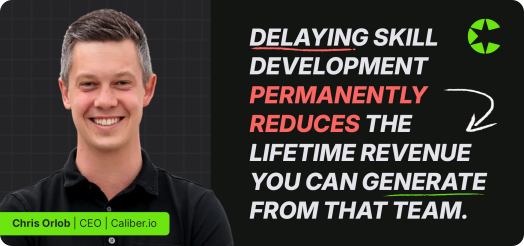
That fact has profound ramifications for revenue leaders.
Just like financial debt, skill gaps that were tolerated for too long ended up harder to fix. This introduces a new term (and mental model) into the revenue leadership lexicon: Skill Debt.
SKILL DEBT: The Sticky Quagmire of Mediocrity
Skill debt is the concept that if you have skill gaps on your sales team, they become more difficult to close the longer they’re left unaddressed. And the skill gaps themselves create negative compounding effects on revenue outcomes.
You know your team is racking up skill debt if:
- You train your team, but the behavior change is like pulling teeth.
- New training programs are met with confusion, indifference, and even skepticism. • Only a few of your sellers lean in hard to new, more effective ways of doing things and you have to drag everyone else along.
- Your team has trouble “snapping out” of well-worn old habits, even if they know they should be doing something differently.
- If any of those are the case, skill debt is starting to silently compound.
Here’s how it typically plays out:
Let’s say your sales team has weak discovery skills: As soon as they hear any sort of need for your product, they start pitching. Hammer, meet nail. They uncover only surface level problems (believing they “did discovery”) and spend the rest of their time “selling value” (Read: talking about the product).
You know you need to upskill them. You’re reminded every time you listen to a call or ride along with them. You even do a few “random acts of coaching” where you can.
But somehow, closing that skill deficit programmatically seems like tomorrow’s problem.
“I’ll get around to fixing that next quarter,” you think to yourself. After all, you’re a little behind on the number this quarter
(And who can imagine why?).
WHY AM I BEHIND?

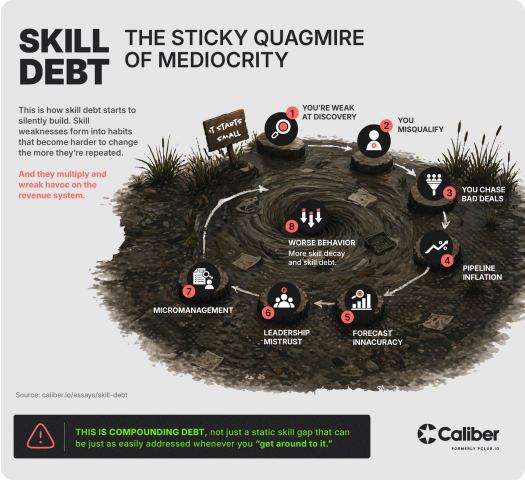
But that’s when skill debt starts to silently build. Skill weaknesses form into habits that become harder to change the more they’re repeated. And they multiply, and wreak havoc on the revenue system.
1. You’re weak at discovery → you misqualify
2. Misqualify → you chase bad deals
3. Chase bad deals → pipeline inflation
4. Pipeline inflation → forecast inaccuracy
5. Forecast inaccuracy → leadership mistrust
6. Leadership mistrust → micromanagement
7. Micromanagement → high-pressure selling, pitching, worse discovery 8. Worse behavior → more skill decay and skill debt
That is compounding debt, not just a static skill gap that can be just as easily addressed whenever you “get around to it.”
Every Quarter You Wait, Skill Debt Builds As you saw in the data, skill debt makes it twice as hard to improve long-standing skill gaps.
Why? Because you’re dealing with human skill and habit.
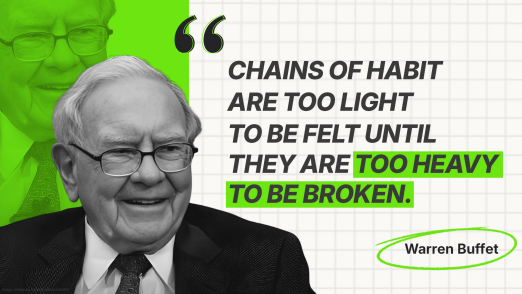
The more people repeat a behavior – the harder it becomes to break.
This is why golf pros have instructors: if you practice something the wrong way, you’re building negative muscle memory that becomes hard to break.
The same thing happens with revenue-critical skills.
That weak discovery skill set across your team? It forms negative “muscle memory.” The longer your sellers run their “weak discovery skill,” the harder it becomes for them to learn a new, more effective way.
And if you keep leaving it unaddressed?
People stop recognizing it as a problem. “That’s just the way we sell here,” they think. So not only are you fighting bad habits, you’re fighting confusion and skepticism.

Left unaddressed long enough, weak skill sets become a gravity pull.
Not impossible to fix. Just heavier than it should be.
The Positive Business Impact of Improving Skill Gaps
The business case for addressing revenue skill gaps is enormous.
Some revenue leaders have not caught onto a fundamental truth:
That revenue outcomes are downstream of highly-skilled sellers.
Addressing skill gaps, coaching, and training your people will have a greater revenue impact than playing deal heroics. It’s just that you won’t feel the impact as immediately as if you “took over” a late-stage opportunity.
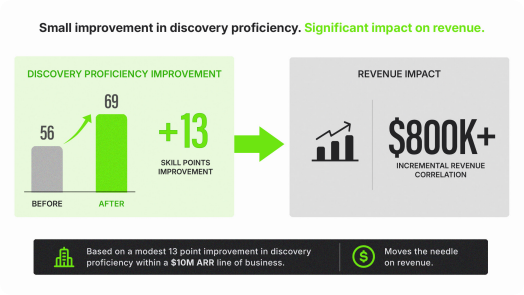
A couple months ago, we worked with one of our clients to analyze the revenue impact of improved discovery skills. Discovery proficiency levels across deals were mapped to the various revenue outcomes they produced.
The result?
A modest [13] point improvement to their discovery proficiency showed an $800,000+ incremental revenue correlation. Given this client runs a $10M ARR line of business, that moves the needle.
Assuming you have product-market fit, a solid ICP, and the fundamentals of a solid go-to market strategy and demand engine in place, growing your organization’s skill capacity is arguably the most durable revenue growth lever.
When your team has:
- Weak discovery skills, conversion rates degrade.
- Weak multi-threading skills, sales cycles get longer
- Weak economic buyer engagement skills, deal sizes stay small
On the other hand, when you have:
- Strong discovery skills, you win more deals
- Strategic multi-threading skills, you close deals faster
- The ability to sell effectively to power, you get access to bigger budgets and bigger deals
- Weak discovery skills, conversion rates degrade.
- Weak multi-threading skills, sales cycles get longer
- Weak economic buyer engagement skills, deal sizes stay small
On the other hand, when you have:
- Strong discovery skills, you win more deals
- Strategic multi-threading skills, you close deals faster
- The ability to sell effectively to power, you get access to bigger budgets and bigger deals
Competitors can copy your features in a focused weekend. But can they match a top caliber revenue organization in terms of skill performance?
That’s a multi-year catch up timeline.
The Negative Business Impact of Skill Debt
I’m friends with a CRO who took over a 500-person B2B tech sales organization about a year ago. This organization has been selling the same way for the last 12 years – high-pressure, discount-driven, transactional selling. All stemming from the hard-charging founder’s DNA.
For a while, that worked for them. Their easy-to-buy, easy-to-understand early product practically sold itself.
But as time went on and they became a multi-product organization (and started to inch their way upmarket), the complexity of their sales motion increased – as did the demand for mastering new enterprise-grade selling skills.
Yet the org was never upskilled to face that new reality in a serious, programmatic, systematic way.
Today, they still sell the same way. And the skill debt they’re accumulated is almost impossible to surmount. They still carry the same skill deficits.
And now they are losing their footing in the market.
They are desperately trying to sell their full suite of new products to prevent hotter, new competitors from taking their future market position, and they’re miserably behind.
As a public company, their stock price has dropped to 1/27th of what it was during its peak in 2021 (which was a bubble, to be sure, but they are being heavily penalized in today’s market by any standard).
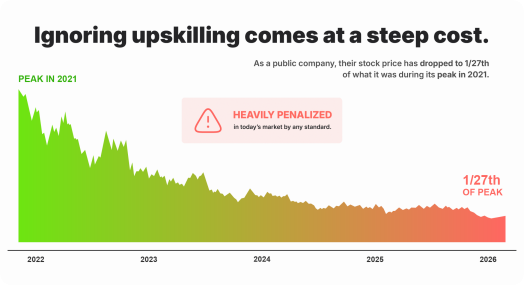
They have waited so long to fix the upskilling problem that it’s like turning the Titanic: slow, painful, and uncertain.
That’s skill debt at its worst.
Their only real shot is serious, non-negotiable, long-term upskilling, reskilling, and even re-hiring.
I shudder to think where they’d be today if they installed a serious, ongoing skill-building program 10 years ago. They would be formidable. Instead, they’re fragile and struggling.
Like I said, “skill debt” works just like financial debt. The longer it’s left unaddressed, the steeper the climb to fixing it.
What to Do About It: Skill Systems > Training Events
Awareness is the first step in solving (or preventing) the Skill Debt problem.
When you realize the urgency that comes with “this will get harder every quarter I wait,” it becomes much easier to prioritize serious upskilling. You realize this is not a nice-to-have enablement-led initiative. It must become an embedded way you manage your revenue organization.
But awareness is still not enough.
Almost all revenue leaders have experienced this:
You hire a trainer (who may or may not have credibility).
You cram every role into the training room (from SMB to Enterprise).
90 days later, nothing sticks.
The real reason skill debt exists is because companies treat skills like one-time training events – instead of managed operating systems.
The solution is installing “skill systems,” not just running training.
What’s the difference?
Training is usually a one-and-done event, possibly followed by some light reinforcement. But ultimately, it has one fatal flaw: it dissipates eventually.
Installing a “skill system” is different.
What It Means to Install “Skill Systems”
High-performing revenue organizations don’t treat skills as something you train episodically.
They treat them as infrastructure – something that is continuously measured, managed, and improved.
They treat skill management as a closed-loop system that compounds capability and revenue outcome. That system has six elements.
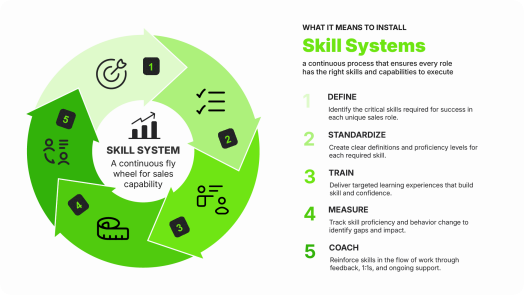
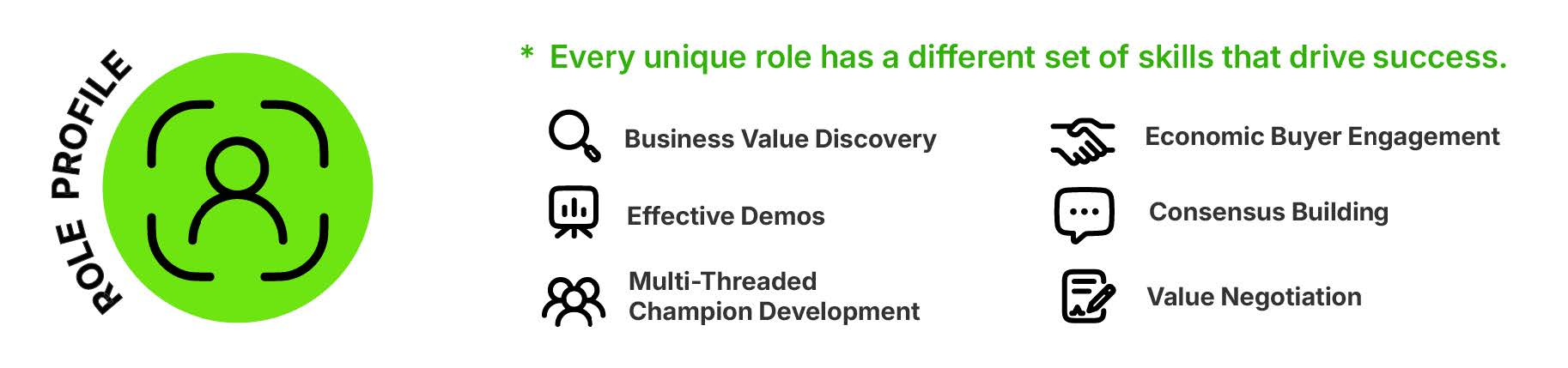
Define the 6-8 concrete skills that matter for each unique role (i.e. SMB AE vs. Enterprise AE vs. Account Managers should all have different skill profiles). The skills should be highly specific behaviors that a sales manager could coach against and a rep can learn about, practice, and drill. Bad example: Value Selling (what does that even mean?). Good examples:
- Standardize the required proficiency levels for each role. Decide what good looks like and what it means to be proficient at each skill. What constitutes Novice?
- Developing? Fair? Proficient? Expert-level? What proficiency level do you demand of your team, and what are the consequences of falling short?
- Train the organization against the skill standards over time. Show them what to do, how to do it, and why, from a trusted, credible source. Give them the canonical blueprint for each given skill.
- Measure seller proficiency levels against each skill as you train them, in live performance scenarios. Passing a knowledge test or exam is not enough. Sellers must show demonstrated proficiency with real behavior evidence.
.jpeg)
- Coach against the skills and skill standards using your frontline managers. Your managers should not just be deal junkies. They should have dedicated sessions with their people solely to coaching them against the skill standards your revenue organization has defined.
Notice that “train” is only one of those parts.
It’s required, but insufficient on its own. That’s why 84% of sales training fails to stick after 90 days, and “skill systems,” as described above, are the solution.
Skill systems are the difference between training as an event, and standardizing skill development as an ongoing operating system and process.
How to Get Started Preventing Skill Debt
Average revenue leaders manage pipeline and leave it at that.
Elite revenue leaders manage capability.
If you want a simple next step, I put together a FREE cheat sheet:
.jpeg)
The future of revenue success isn’t better training. It’s skill systems that prevent skill debt.
In a world distracted with AI, tools, and shiny objects, the revenue leaders of the future don’t just manage deals and pipeline. They manage capability.
Because they know one thing:
Revenue is downstream of highly capable sellers.
If you liked this, spread the word and share it with a sales leader.