Richardson vs pclub.io

Richardson vs pclub:
B2B Sales Training Programs for Modern SaaS Teams

Modern SaaS teams are selling into longer cycles, larger buying groups, and tougher scrutiny.

The issue is not effort. It is skill capacity.

Across the workforce, the skill gap is so wide that nearly half of workers will need to be retrained this decade. That’s why more revenue leaders are shifting their focus from traditional training toward modern B2B sales training programs that build palpable skill capacity.

Richardson Sales Performance provides teams with a structured, consultative framework. pclub takes a continuous, data-driven approach that diagnoses skill gaps, trains them, reinforces behavior, and measures impact over time.

Here’s how the two programs stack up, and guidance for choosing the right one.

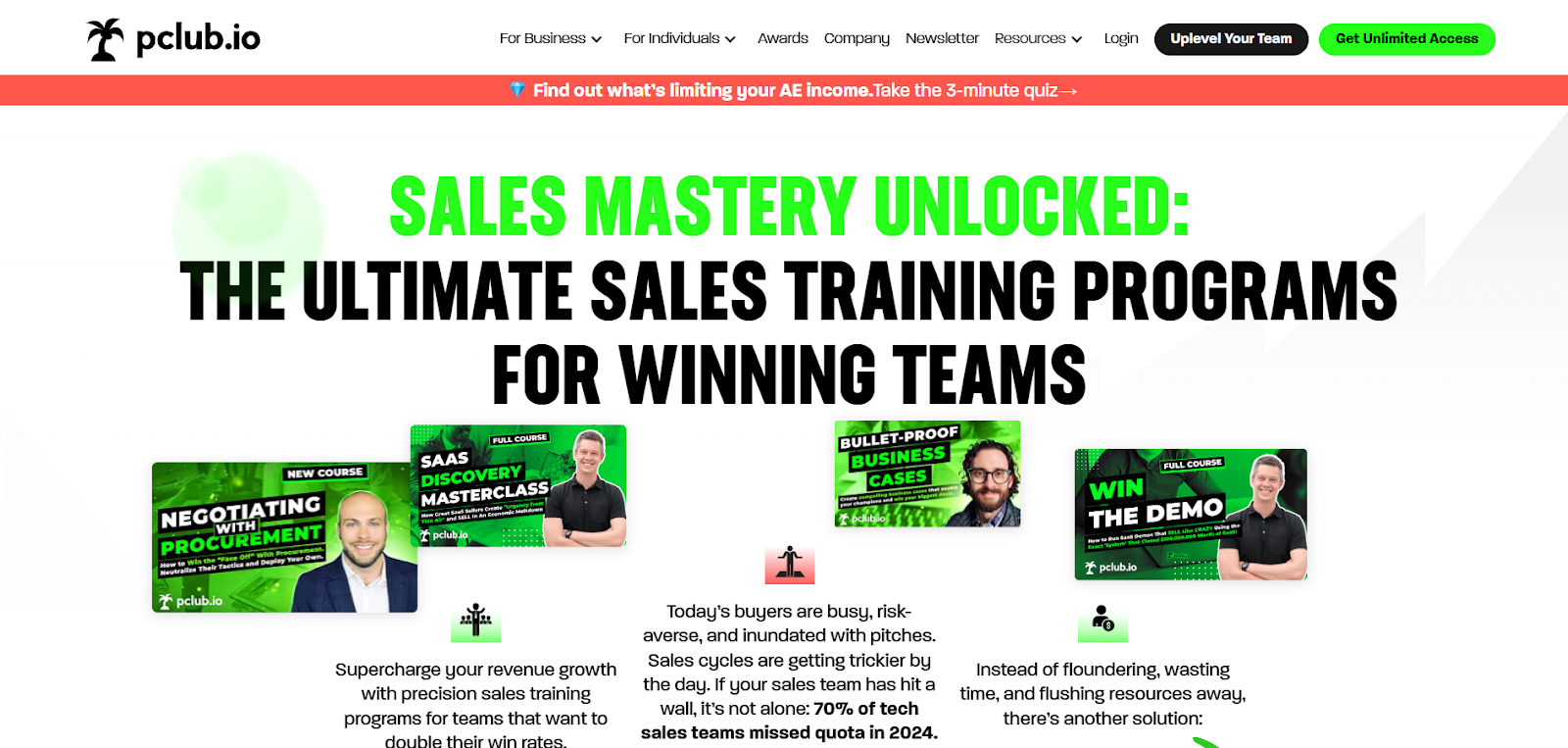
Overview: pclub’s B2B Sales Training Programs

pclub is built for teams that want more than one-time workshops. It combines targeted instruction, practice, reinforcement, and measurement in one system.

pclub is not:

White stylized X inside a black circle with a red outline around it.
Broad, generic sales training
White stylized X inside a black circle with a red outline around it.
A library of recorded content
White stylized X inside a black circle with a red outline around it.
Dependent on one kickoff event
White check mark inside a green circular outline on a transparent background.

pclub offers:

White check mark inside a black circle with a glowing green outline.
Role- and segment-specific learning paths
White check mark inside a black circle with a glowing green outline.
Expert-led instruction
White check mark inside a black circle with a glowing green outline.
AI sales role play tied to what reps just learned
White check mark inside a black circle with a glowing green outline.
Embedded measurement and accountability
White check mark inside a black circle with a glowing green outline.
An always-on loop for continuous improvement

The table below breaks down pclub and Richardson sales training across the areas that tend to matter most in day-to-day execution, practice, reinforcement, role fit, and measurable impact, so you can quickly see which approach aligns best with your team’s goals and operating reality.

Category
pclub
Richardson
Best for
Teams that want continuous, data-driven skill development tied to revenue outcomes
Teams that want a structured consultative selling framework
Core approach
Diagnoses skill gaps using sales data, then prescribes training, AI practice, reinforcement, certification, and measurement
Blends consultative selling with Challenger-style methodology to improve rep conversations
Training cadence
Continuous, closed-loop development
More program-based and episodic
Practice model
AI role plays tied to specific lessons and rep context
Workshops, coaching, and methodology application
Customization
Role-, segment-, and vertical-specific paths for SDRs, AEs, AMs, and managers
More framework-led and broadly applied
Reinforcement
Embedded enablement, certifications, repeated measurement, and ongoing iteration
Depends more heavily on manager coaching and post-training follow-through
Measurement
Tracks revenue impact and skill-gap improvement directly
Typically measured through the adoption of framework behaviors and coaching effectiveness
Strength
Modern skill transformation infrastructure
Strong foundation for consultative selling consistency
Limitation
Better suited for teams ready to operationalize continuous development
Skill retention can decay without systematic reinforcement

How pclub Works

Here’s a breakdown of what the pclub sales transformation process looks like.

1. Diagnose

pclub analyzes sales data and conversational signals to identify skill gaps tied to revenue opportunities.

2. Train

Reps get role-based training tailored to function, segment, and selling context.

3. Practice

Reps use AI sales training software to rehearse new skills before live deals.
4. Reinforce and Certify

Managers and enablement teams get support, reinforcement, and certification paths that help behavior stick.

5. Measure

Leaders can see how to measure sales training effectiveness through behavior change, pipeline movement, and revenue outcomes.

6. Repeat

The cycle starts again, so development compounds over time.

Where Richardson Shines

Richardson is strongest when a team needs a shared framework for consultative selling. It helps reps uncover buyer needs, connect solutions to business outcomes, and improve consistency in sales conversations.
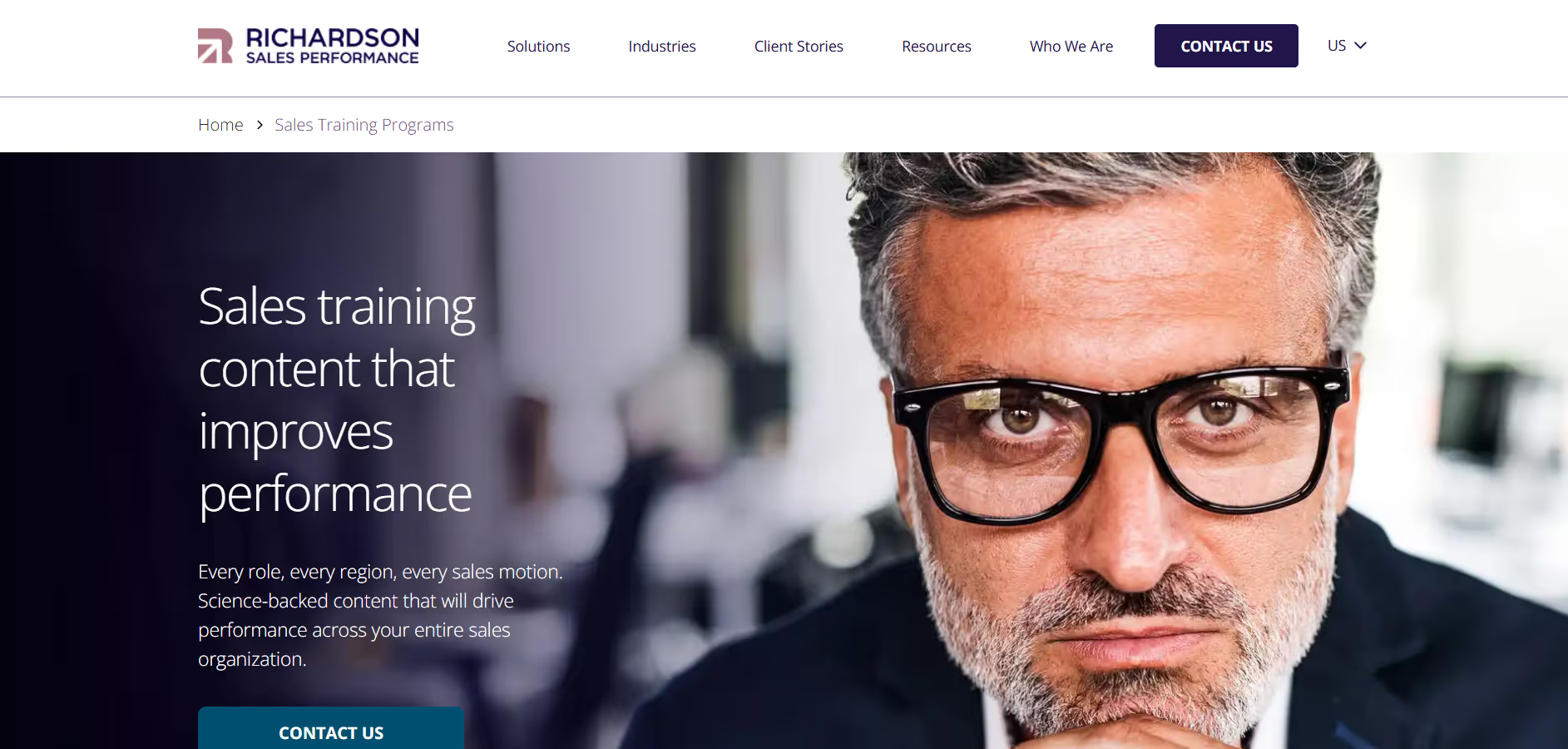
That said, the source draft also makes clear that Richardson is more program-based than continuous. Without systematic reinforcement, skills can fade after training, which is one reason why sales training fails to create lasting behavior change. 

Quick Pick Guide
for B2B Sales Training

Which of these B2B sales training programs should you choose?

Here’s a quick framework for deciding which approach best fits your needs.

Choose pclub If…

pclub is designed for organizations that want to continuously increase skill capacity across the entire revenue team.

It’s a strong fit when:

  • You want ongoing reinforcement instead of one-time training
  • You need targeted development for skills like discovery, executive access, or multi-threading
  • Leadership needs clearer visibility into sales enablement ROI
  • You want measurable improvement, not just course completion

Choose Richardson If…

Richardson may be the right fit if your organization is focused on establishing a consistent selling framework across the team.

Consider Richardson if:

  • You need a consultative selling methodology first
  • Your managers have time to coach and reinforce
  • Your main goal is process consistency across the team

Drive Revenue With Skill
Transformation Infrastructure

The core choice is simple: Richardson is a strong framework play, while pclub is built as a continuous skill infrastructure. For modern teams asking, “How do you evaluate sales training programs?” the answer is not just content quality. It is reinforcement, practice, and measurable business impact.

Don’t leave more revenue on the table.
Explore pclub.io’s offerings today.

FAQ

Still weighing the difference between Richardson and p.club? These common questions can help clarify how each approach supports modern SaaS sales teams.
What is the best sales training for B2B teams?
The best sales training depends on your goals. Richardson is strong for teaching structured consultative selling frameworks and Challenger-style behaviors. pclub is better suited for teams that want a continuous, data-driven system to diagnose skill gaps and continuously improve sales execution.
Why does sales training fail so often?
Sales training often fails because it’s episodic and poorly reinforced. Programs like those from Richardson can introduce strong frameworks, but without consistent reinforcement, new behaviors fade. pclub addresses this by embedding continuous practice, reinforcement, and data-driven feedback into daily selling workflows.
How do you evaluate sales training programs effectively?
To evaluate sales training, focus on how well the program develops and reinforces real selling skills.

Richardson is effective when teams need a consistent consultative framework and coaching structure. pclub stands out when organizations want data-driven skill diagnostics and targeted development paths tied to revenue performance.
How do you measure sales training effectiveness?
Sales training effectiveness should be measured through behavior changes and deal performance, not just completion rates. With Richardson, organizations often track adoption of consultative selling behaviors and coaching engagement. pclub goes further by linking skill development directly to metrics like win rates, pipeline conversion, and deal velocity.
How do you prove sales training ROI?
Sales team training ROI is measured by improvements in revenue-driving metrics such as win rates, deal size, and sales cycle length. With pclub, ROI can be tied directly to closing specific skill gaps that impact revenue performance.