

The Three Forces That Created the Global Revenue Skills Crisis


We are in the early innings of the largest global revenue skills crisis the modern economy has ever seen. Skill capacity — across SDRs, AEs, CSMs, and even frontline managers and revenue leaders — has collapsed to historic lows.
This decline in skill capacity is now costing trillions in enterprise value and billions in missed revenue every year.
And 90% of revenue leaders cannot explain what’s happening to their board or ELT teams:
• Weak close rates
• Weak attainment
• Weak pipeline
All chalked up to “headwinds.”
But it’s bigger than that.
I’ve been in the walls of 5,000+ revenue teams in 15 years:
The scaling years of InsideSales, Gong, and now pclub.io
Here’s what I’m seeing:
We're in a global skills crisis.
Three macro forces have collided at once:
1. The economy changed
Growth is no longer bought through budgets, headcount, or inefficient marketing spend. Skill is the new growth lever.
Just a few years ago, selling was easy:
• Hot economy
• Loose budgets
• Buyers were buying
That era created skill atrophy.
Nobody invested in skill capacity. Because nobody had to.
Revenue grew on the back of a macro wave – not revenue excellence or tight sales acumen.
That changed abruptly:
• Demand-negative conditions
• Risk averse economic buyers
• Larger buying committees
• Higher purchase scrutiny
Today?
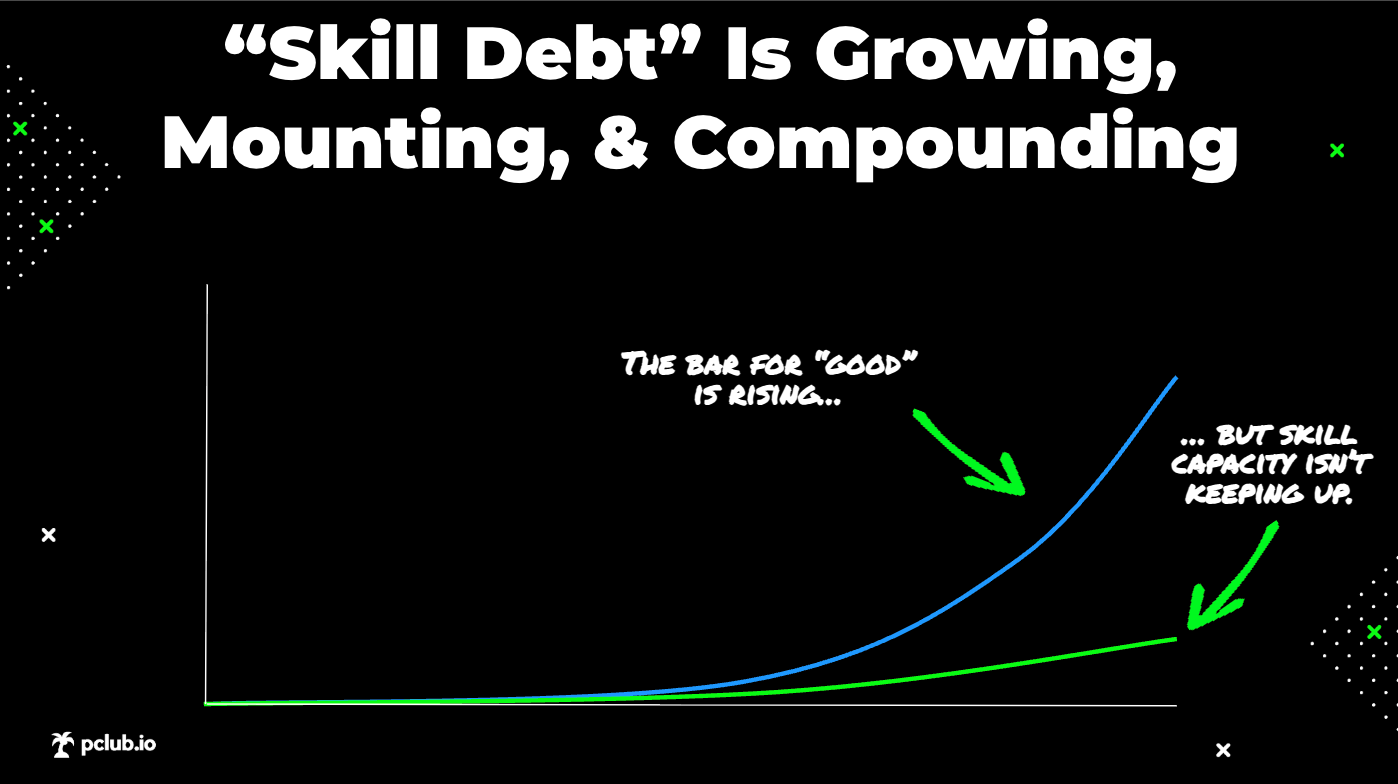
95% of teams still have the same skill capacity they had a few years ago during the go-go days.
The demands for excellence are 10x higher.
Yet “actual” excellence has flatlined and even declined.
2. The revenue workforce changed.
We’re entering the least experienced revenue workforce in modern history — remote work that limits learning, a younger generation, and high turnover and job switching have hollowed out the talent base.
Look at the typical SDR, AE, AM, even manager today.
Compare that to 10 years ago.
It’s a stark contrast:
• Less experienced
• Digitally-native
• Remote-first
Most entered the workforce during or after the pandemic:
• Selling from bedrooms
• Didn’t get the training you did
• Coached by first-time managers
And the first innings of their career are happening in the hardest selling environment we’ve seen in decades.
3. The job changed.
Buyers self-educate. Committees have doubled in size. AI has reshaped workflows. The pace of change has exceeded the pace of upskilling.
You already have a tough economy.
You already have an underprepared workforce.
Now they have to face off with the most sophisticated buyers in history:
• AI prompts compare you to competitors
• Wealth of information at their fingertips
• No tolerance for bad sales experiences
At the same time revenue acumen flatlined? Buyer acumen skyrocketed.
And this isn’t a static problem.
Just like any problem, it gets worse with time if left unaddressed.
In the world of high achieving revenue executives that I spend most of my time in, we call that “Skill Debt,” and it has a profound negative impact on revenue outcomes:
Where do we go from here?
When you combine these three forces:
• The economy changed
• The workforce changed
• Buyer sophistication changed
… A global revenue skills crisis is not just likely.
It’s inevitable.
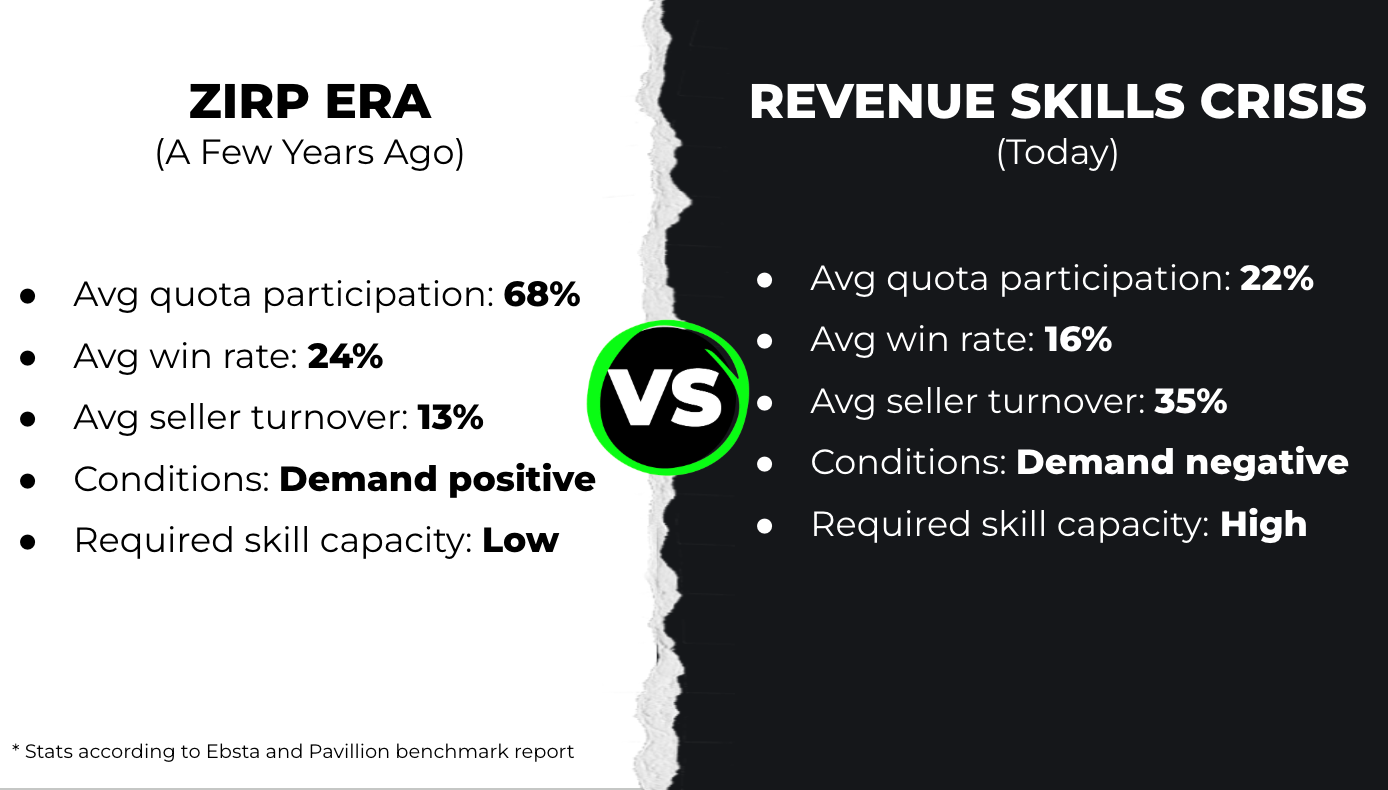
According to Pavillion’s research, in just the last few years:
• Quota participation fell from 68% to 22%
• Close rates are down from 24% to 16%
• AE turnover jumped from 13% to 35%
The good news?
You can now explain to your board what’s happening.
It’s not just headwinds.
It’s a global revenue skills crisis.
In fact, about 20% of the CROs I speak with ask for this slide deck (Global Revenue Skills Crisis Overview) so they can explain to their C-Suite colleagues and board what they’re up against.
You’re welcome to do the same:
Most of your colleagues won’t see this until you make them aware.
But the next question they’ll all ask you becomes:
“What are you doing about it?”
Here’s the best answer:
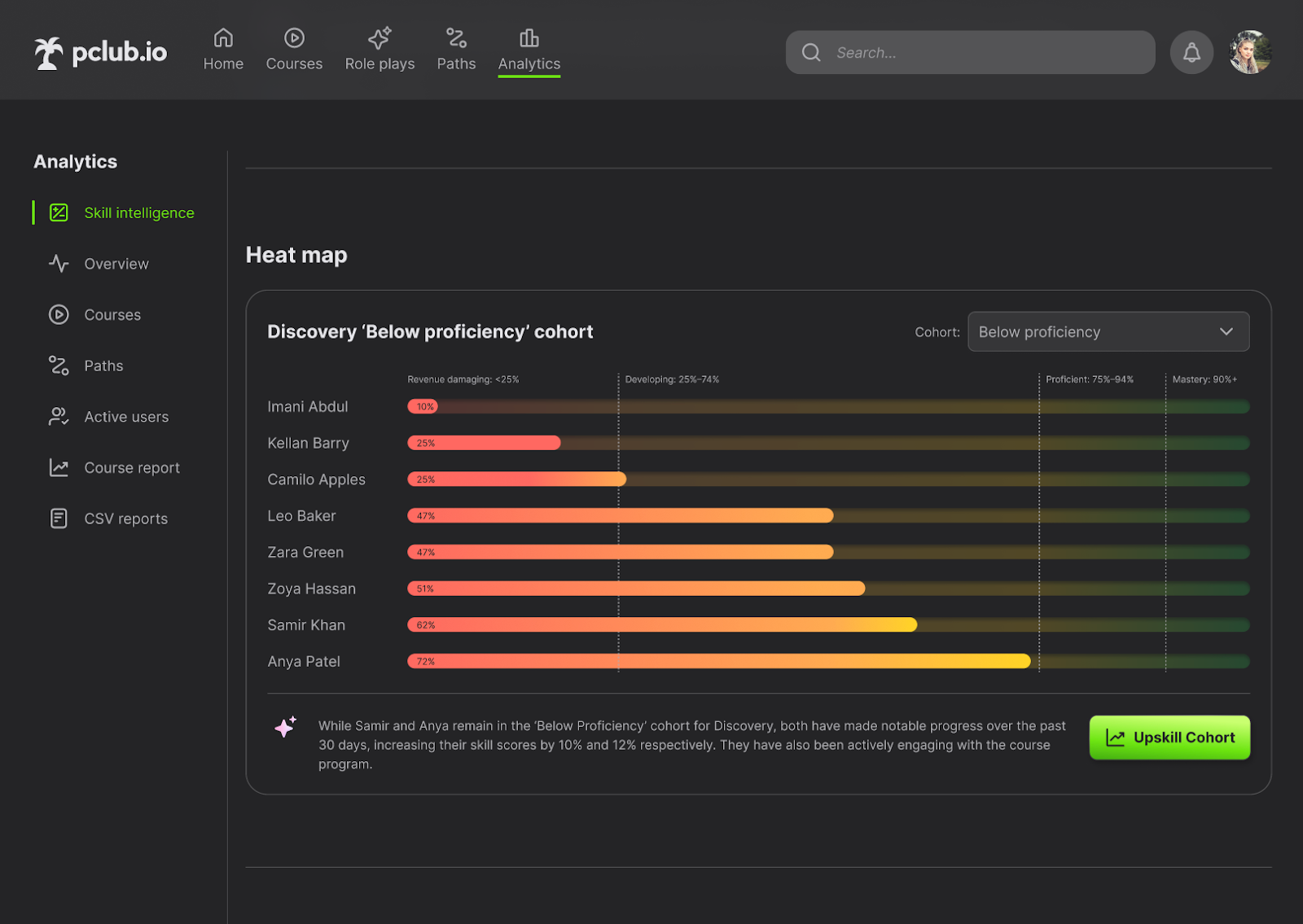
Realize that skill capacity is a monetizable revenue-producing asset. It must be treated as infrastructure:
Old world:
• One-and-done training events
• Blanket enablement
• Keynotes at SKO
• No measurement
• Just content
New world:
• Revenue skills as infrastructure
• Targeted intervention programs
• Closed-loop systems > content
• 4-week reinforcement cycles
• Measured revenue impact
Revenue enablement leaders are no longer training organizers.
They are builders of a revenue-impacting operating system.
One that turns a hollow sales process into incremental revenue.
Nail that?
You unlock revenue excellence.
In the last decade, revenue grew on macro tailwinds. In the next decade, it will only grow on skill.